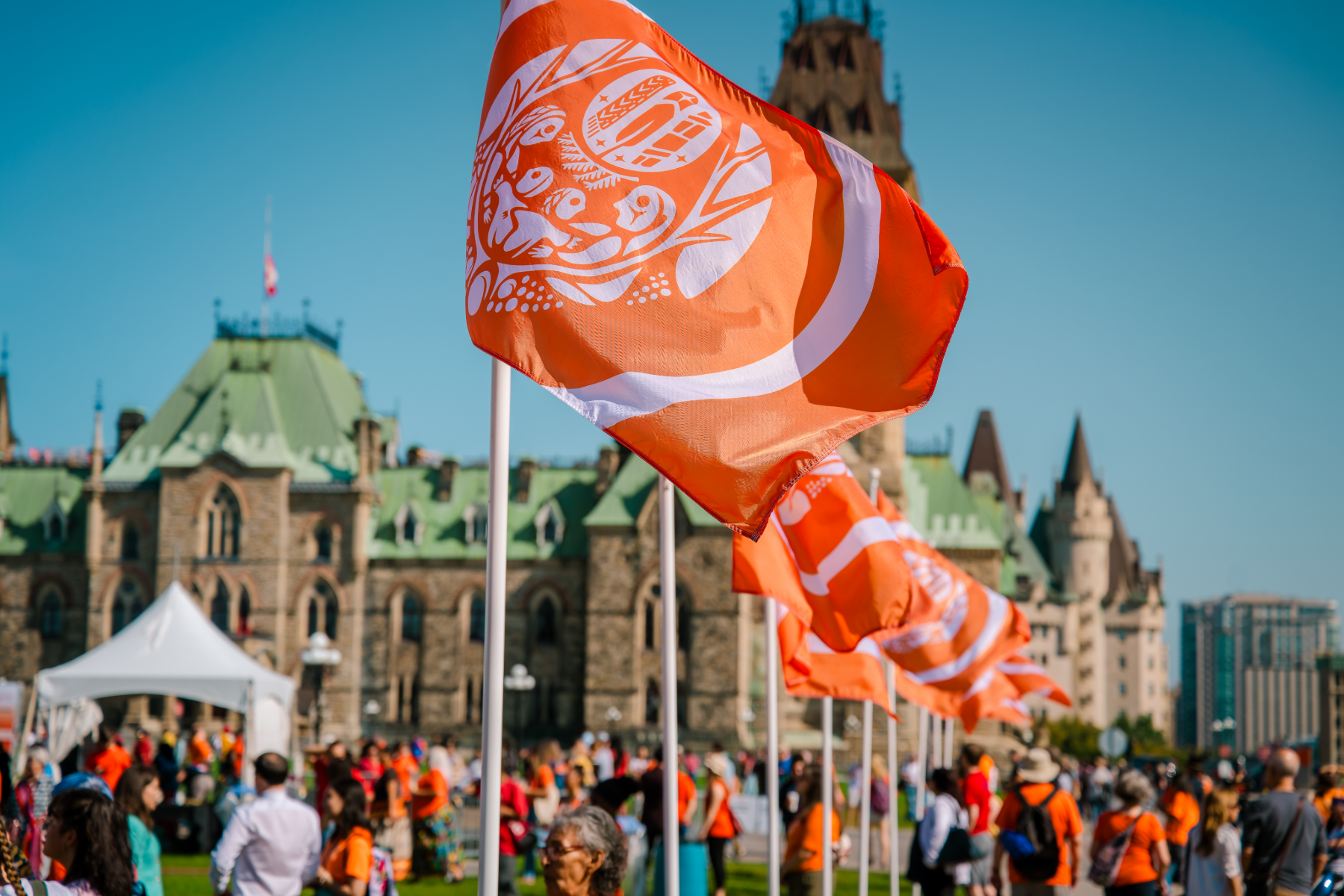
Survivors’ Flag raised on Parliament Hill to honour Residential School Survivors and the children who never came home
September 30, 2026 — Ottawa, Ontario, Algonquin Traditional Territory, — Crown-Indigenous Relations and Northern Affairs Canada and National Centre for Truth and Reconciliation
Today, First Nations, Inuit, and Métis residential school Survivors gathered on Parliament Hill, on the unceded traditional territory of the Algonquin Anishinabeg Nation, to raise the Survivors’ Flag in honour of Survivors and in memory of the children who never returned home.
Survivors, Elders, and representatives of the National Centre for Truth and Reconciliation (NCTR) were joined by leaders of national Indigenous organizations, Her Excellency the Right Honourable Louise Arbour, Governor General of Canada, and the Honourable Rebecca Alty, Minister of Crown-Indigenous Relations.
The residential school system forcibly separated Indigenous children from their families, communities, cultures, and identities. Children experienced profound harm, and the impacts of the residential school system continue to affect Survivors, their families, and communities across generations.
The Survivors’ Flag honours the children who never returned home and recognizes the strength, courage, and strength of Survivors. Its presence on Parliament Hill serves as a reminder of this painful history and of the responsibility to remember, listen, and act.
Raising the Flag provides an opportunity for Canadians to listen to Survivors and learn from their truths.
Advancing truth and reconciliation is an ongoing collective responsibility, requiring continued action to recognize Indigenous rights, support self-determination, and transform the relationship between Canada and First Nations, Inuit, and Métis.
Quotes
“The Survivors’ Flag stands as a testament to the courage and strength of those who have carried the weight of the past while continuing to move forward with hope. Its presence reminds us that reconciliation requires action, understanding, and a collective commitment to honour Survivors, learn from history, and create lasting change for future generations.”
Elder Claudette Commanda
Algonquin Anishinabeg Nation
“Having spent 12 years in Residential Schools, I know the importance of remembering our shared history. The Survivors’ Flag is more than a symbol. It is a recognition of the experiences of Survivors, a tribute to our power, and a reminder that reconciliation requires truth, understanding, and action.”
Antoine Mountain
First Nations Survivor
“The experiences I endured as an Inuit child in Residential School followed me into adulthood, shaping my journey in profound ways. While the path has not always been easy, it has shown me that healing, belonging, and love are possible. Being here today at the raising of the Survivors’ Flag is a powerful reminder that our stories matter, that our courage is honoured, and that hope continues to guide us forward.”
Bernard Andreason
Inuit Survivor
“As a Survivor of the Île-à-la-Crosse Boarding School, I am proud to see the Flag raised and to see Métis people represented in this way. The past has given us a lot of hurt, but now is the time to honour our journey, reclaim our future, and move forward together with strength and pride.”
Ann Lafleur
Métis Survivor
“Survivors have shown immense courage in sharing their truths and helping future generations understand our history. We raise this Flag in honour of their strength. The Residential School system spanned generations, leaving impacts that continue to be felt today. Truth and reconciliation cannot undo that history. We have a long walk ahead of us, one that calls for humility, perseverance, and meaningful action. May the Survivors’ Flag serve as a lasting reminder that reconciliation requires all Canadians to walk that path together.”
Stephanie Scott
Executive Director, National Centre for Truth and Reconciliation
“Raising the Survivors’ Flag on Parliament Hill is an opportunity to honour Survivors, remember the children who never came home, and reflect on the truths that have been shared with Canadians about Residential Schools. We are reminded that reconciliation is an ongoing responsibility that belongs to all of us. By listening to Survivors, confronting attempts to deny or diminish this history, and advancing the rights and self-determination of First Nations, Inuit, and Métis, we can continue the work of building a stronger, more just country together.”
The Honourable Rebecca Alty
Minister of Crown-Indigenous Relations
Quick facts
- The Survivors’ Flag was first raised on Parliament Hill in August 2022.
- The Survivors’ Flag was created for—and by—Survivors to honour all Survivors, families and communities affected by the Residential School system in Canada and to share their expression of remembrance across the nation.
- The Flag was developed through consultation and collaboration with Inuit, Mi’kmaq, Atikamekw, Cree, Ojibway, Dakota, Mohawk, Dene, Nuu-chah-nulth, Secwepemc, and Métis Nation Survivors.
- The National Centre for Truth and Reconciliation (NCTR), hosted by the University of Manitoba, was created as a place of learning where the truths of Survivors are honoured and kept safe for future generations.
- The NCTR works with Indigenous and non-Indigenous educators, researchers, communities, decision-makers, and the public to support the ongoing work of truth, reconciliation, and healing across Canada and beyond.